Nicolás Maduro's outfit goes viral after picture following capture

In the hours following the United States'early morning strike in Venezuelaand capture ofNicolás Maduro, a photo of the Venezuelan leader blindfolded aboard a ship was posted to the social media platform Truth Social byPresident Donald Trump.

That photo has since gone viral, not only for Maduro's subdued appearance but also for his outfit: a gray Nike Tech sweatsuit. Nike Tech fleeces, jackets, pants and sweatsuits have drawn cultural commentary in recent months, with a social media trend inspiring young men to ditch the outerwear style inexchange for quarter-zipsand the perceived sophistication that comes along with the article of clothing.

While the detainment of the country's leader and strikes on the country have been drawn mixed reactionsfrom Venezuelans and people around the world, Maduro's outfit has sparked memes and social media videos.

Venezuelan leader Nicolás Maduro, pictured here after his capture aboard the USS Iwo Jima, is seen in this handout image posted by U.S. President Donald Trump on Truth Social Jan. 3, 2026. The United States captured Venezuelan leader Nicolás Maduro and his wife in an overnight military operation on Jan. 3, 2026, President Donald Trump said, as explosions rocked Caracas and targets across the country.

Is Greenland next?Trump renews takeover calls after Venezuela strike

Nike Tech is 'out' in viral style trend

In November 2025, aviral TikTok videoby user Jason Gymafi declared that young men who want to be respected and feel good about themselves should wear quarter-zips instead of Nike Tech sweaters. Gymafi'squarter-zip video, where he and friend Richard Minor are seen wearing the sweaters and swirling matcha drinks, amassed nearly 30 million views as of Dec. 15.

"We don't do Nike tech. We don't do coffee. It's straight quarter zips and matchas around here," Gymafi says. "He [Minor] was talking about putting on a Nike tech to come outside. I told him, 'What are you doing? You've upgraded in life. You wear glasses now. You wear quarter zips now.'"

That video sparked a movement that saw men meeting up in their best quarter-zips to drink matcha and mingle while denouncing the Nike Tech. That mentality toward the article of clothing is now reflected in the response to Maduro's outfit in the photos of his capture.

'It's a lifestyle':Quarter-zips are having a moment. Here's why

The internet reacts to Maduro's outfit

The term "Nike Tech" saw a spike in searches on Google Saturday morning, Jan. 3,following Trump's poston Truth Social, according to Google Trends.

On TikTok and Instagram, many posts containing the photo of Maduro while captured have comments underneath criticizing the leader's outfit, including, "Why does bro got on Nike tech," and "Bro didn't get the update of quarter zips."

Other posts also reference the leader's outfit, some theorizing that Maduro was intentionally put into the outfit. One TikTok video said the outfit meant he was "just asking to be a meme."

"If he was wearing a quarter-zip, he would still be fine. He'd still be doing his thing. But he wasn't," said TikTok user @brooklyngabby in a video with over 16,000 likes as of Sunday afternoon, Jan. 4. "He was caught slacking, he was in his Nike Tech, he was not in his quarter-zip sweater."

Photos:See reactions after US explosions in Venezuela, Maduro capture

Kate Perez covers national trends and breaking news for USA TODAY. You can reach her at kperez@usatodayco.com or on Twitter @katecperez_.

This article originally appeared on USA TODAY:Nicolás Maduro's outfit in capture photo goes viral on social media

Nicolás Maduro's outfit goes viral after picture following capture

In the hours following the United States'early morning strike in Venezuelaand capture ofNicolás Maduro, a photo of th...
Berlin power outage affecting 45,000 homes blamed on 'politically motivated' attack

BERLIN (AP) — Many households and businesses in south-westBerlinface days without electricity after high-voltage power lines were damaged by a fire which city authorities said Sunday was a result of a politically motivated attack by "left-wing extremists."

The fire broke out on Saturday morning on a cable bridge over the Teltow Canal, near the Lichterfelde power plant, according to local authorities. Initially, over 45,000 households and 2,200 businesses in four districts were without electricity. Heating and internet services were also affected.

Franziska Giffey, the city's Senator for Economic Affairs, described the incident as "a particularly severe power outage affecting tens of thousands of households and businesses, including care facilities, hospitals, numerous social institutions and companies."

While power was restored to thousands of households by Sunday, many others are likely to be left in the dark until Thursday, authorities estimate.

Snowy weather and freezing temperatures has slowed down efforts to restore electricity and made life extra difficult for those affected.

The incident is being investigated as a possible act of arson. Authorities compared it to a similar power outage last September in southeast Berlin, when radical activists claimed responsibility.

Authorities said they were working to confirm the authenticity of a letter claiming responsibility for thelatest incident.

The perpetrators were "clearly left-wing extremists," Berlin's Mayor Kai Wegner was cited as saying by a German news agency. "It is unacceptable that once again clearly left-wing extremists have attacked our power grid and thereby endangered human lives," Wegner said.

Berlin power outage affecting 45,000 homes blamed on ‘politically motivated’ attack

BERLIN (AP) — Many households and businesses in south-westBerlinface days without electricity after high-voltage power li...
Photo illustration of hands holding phone, on the phone screen: a magnifying glass and ABC block letters  (Leila Register / NBC News; Getty Images)

A social media frenzy that began in Minnesota overallegations of day care fraudhas rippled into at least seven other states over the past week, as conservative journalists and right-wing influencers have embraced the idea that they should investigate state-subsidized child care centers, especially those run by local people of Somali descent.

In the days since Christmas, conservative content creators have been showing up at day care centers from Ohio to Washington state, recording videos of themselves trying to interview employees and expressing suspicion over whether the centers are legitimate businesses. Like Minnesota, Ohio and Washington also have significant Somali populations.

NBC News viewed similar videos on social media investigating day care centers in Idaho, Maine, Massachusetts, Oregon and Pennsylvania.

Many of the people making the videos are affiliated with small conservative websites or have ties to political groups. The clips have been posted to X, where some have racked up millions of views and praise from viewers, with help from a network of prominent right-wing influencers on the platform who share and reuse the content.

The videos have sparked a national debate about the tactics of right-wing media figures, with some Republicans praising the conservative creators for spotting potential red flags, while some Democrats and immigrant advocates warn that the confrontational tactics amount to harassment. Day care center operators — in particular, many people of Somali descent who have not been charged with any crime — are caught in the middle.

The attention on Somali business owners has its origins partly in along-running federal investigationof fraud in Minnesota that has been going on sinceat least 2022. That investigation, which has had bipartisan support,has led to dozens of convictions, and many of the fraudsters in that case were of Somali descent.

But President Donald Trump has used those charges as justification for hisdisparaging remarks attacking Somalipeople as a community. And right-wing influencers have run far beyond prosecutors, flooding social media with amateur sleuthing of their own that often has thin evidence and is missing context.

The videos gained traction in right-wing social media circles after Nick Shirley, a conservative content creator, posted a lengthy video on Dec. 26purporting to showchild care facilities in Minnesota that weren't operational but were receiving state and federal funds.

Shirley's video has received 135 million views on X and 3 million more on YouTube, and although it did not prove fraud and his tactics have been criticized, it received wide praise from conservatives online andwithin the Trump administration, including from Vice President JD Vance and tech billionaireElon Musk. And it led some of the most followed right-wing influencers on X, such as "Catturd" and "Gunther Eagleman," to call for all Somali immigrants to be deported to get rid of fraud.

Turning Point USA spokesman Andrew Kolvetsaid thatthe allegations of fraud at Minnesota day care centers is "so big, it's so important, because it's going to unlock a lot of other storylines that we're going to see play out in 2026."

At the heart of Shirley's video and others like it is an unproven belief that Somali immigrants are disproportionately committing widespread fraud through day care centers that receive state or federal subsidies for looking after children, but which the content creators suspect are conducting little or no business.

On Tuesday, the U.S. Department of Health and Human Services said it wasfreezing all federal child care paymentsto the state of Minnesota Shirley's video drew national attention.

Now, other influencers are creating imitations of Shirley's video in additional states.

Cam Higby, who describes himself as an "America-first independent journalist," said on X that he visited four separate child care locations on Dec. 30, to investigate what he believed could be potential fraud — all in Washington state, and all run by Somalis, he said.

Higby and a second conservative journalist, Jonathan Choe, have created multiple videos from the visits, including one where someonecloses a front dooron Higby after he asks for a day care application. Inanother video, someone Higby calls "my decoy" goes inside a day care center and reports back to him that she did see children inside and believed they were acting suspiciously.

In posts on X and in videos, Higby and Choe compare two sets of state records: historical spending records for how much money each day care center has received as a contractor for providing subsidized care, and point-in-time records for how many children each center was looking after in late December.

Based on their interpretation of those records and of day care employees' behavior, the influencers often make far-reaching claims about criminality.

The comparison can be misleading because it pits long-term subsidy totals against a one-day enrollment snapshot.

"Just uncovered another SEVEN FIGURE case of obvious Somali daycare funding abuse," Higbywrote on X on Jan. 1, in reference to one of the centers he visited.

In one video, Choe makes a call for "other citizen journalists, other volunteer sleuths" to take up similar work documenting the comings and goings at child care centers. The style of the videos borrows heavily from investigative exposés, with footage from inside moving vehicles and attempted interviews on people's doorsteps.

In a phone interview Friday, Higby acknowledged that he had not found conclusive evidence of wrongdoing by day care centers.

"It could very well be that the day cares themselves are acting within the law," he said.

He said he was drawn to the topic because the numbers he was seeing online did not make sense to him, and he said that neither state officials nor day care owners would help him, so he posted his work online.

"I've been trying to word things so that it's obvious that I'm just digging," he said. "My goal is just to point out: Something is not adding up with this situation. Something is fishy."

He also defended his decision to focus on Somali day care center, to the near exclusion of others.

"We have been to at least one that was non-Somali, but we're looking primarily at Somali ones because that's where the spotlight is now and also that's where the abuses are that we've seen," he said.

Both Higby and Choe are rising creators within the conservative media ecosystem who have worked on the ground in other political hot spotssuch as Portland, Oregon, earlier this year. On Friday, they announced on X that they had also launched a joint legal defense fund in case someone sues them over their work.

The trend took off on social media during a time period — the week between Christmas and New Year's Day — that is typically slow for day care centers.

Seattle's newly elected mayor, Katie Wilson, was among the Democrats to condemn the activity of right-wing influencers. Without mentioning specific influencers, she saidin a statement Thursdaythat she stood with Somali child care providers who had experienced "targeted harassment" and "the surveillance campaign promoted by extremist influencers."

Washington Attorney General Nick Brown, a Democrat, said in a statement Tuesday that his office hadheard reports of harassmentfrom members of the Somali community "accused of fraud with little to no fact-checking."

"Showing up on someone's porch, threatening, or harassing them isn't an investigation," he said. "Neither is filming minors who may be in the home."

A Trump appointee, Harmeet Dhillon, who runs the Department of Justice's civil rights division,fired back at Brownon X, warning him not to "chill or threaten to chill" a journalist's First Amendment rights. Brownthen repliedthat he hadn't "threatened anyone, especially not journalists."

Choesaid on Xthat police officers responded on Tuesday to one of the day care centers he had visited in Federal Way, Washington. A spokesperson for local police confirmed they received a complaint from a resident about people filming their residence while standing on a sidewalk, but the officer determined no crime occurred, the spokesperson said.

Renée DiResta, an associate professor at Georgetown University studying political narratives on social media, said the rapidly expanding campaign has gained fuel from elected officials echoing the influencers' concerns. That in turn inspires others to join in by filming themselves visiting facilities and attempting to repeat the narrative in their town.

"There's already a belief within the online faction that a thing has happened," DiResta said, "and what is happening now is they are backfilling the belief with justification. This isn't evidence to conclusion — it's belief to justification."

Some of the amateur sleuthing is missing important context, said Nancy Gutierrez, a spokesperson for Washington's Department of Children, Youth & Families. For example, a post on Xwith 4.4 million viewsalleged that it was suspicious for a child care center to not list a street address in a state-run online database of providers; Gutierrez said that in-home child care providers are not required to put their address on public databases.

Most of the right-wing figures making such videos generally do not explain how they decide which day care centers to scrutinize, but across multiple states, their targets appear to be of Somali descent. That, in turn, has fueled accusations that they are basing their decisions on whom to investigate solely on the targets' country of origin.

Edward Ahmed Mitchell, national deputy director of the Council on American-Islamic Relations, an advocacy group for Muslims, said he believes there is no reason for social media influencers to target Somali immigrants other than racism.

"There are very obviously fascists and other bigots who want to turn this controversy in Minnesota into a nationwide campaign to harass Somali-Americans," he said.

Mitchell said that racists are exploiting the existence of real fraud prosecutions in Minnesota to try to smear people of Somali descent regardless of where they live.

"It would be insane to do this to the Jewish community or the Black community or the white community," he said. "I've never seen a feeding frenzy directed at an entire race of white people when a white person commits a crime."

Before the spread of fraud accusations, right-wing figures had already been attacking Minnesota's Somali population for other reasons. In September, Musk retweeted a post arguing that Somalis were replacing the state's white population. In July, Shirley posted a video aboutMuslims in Minnesota, although it received far fewer views than his fraud video.

The conservative media ecosystem appears to be hungry for more videos like Shirley's viral fraud post. The CEO of far-right video platform Rumbleposted on Wednesdaythat he wanted to strike a deal with Shirley. And some users on X have urged others on,such as with one suggestionto ask AI "for an extensive list of daycares in your city…. Then go hunting!!!"

In Ohio, over 40 Republican lawmakers cited the allegations on social mediato call forincreased audits and unannounced inspections of day care centers in Columbus by state officials. Columbus has the second-highest concentration ofSomali immigrantsin the United States, behind theTwin Citiesarea.

State Rep. Josh Williams, a Republican from the Toledo area who is running for Congress, saidhe wantsthe state to use the power it already has to look at all day care centers and either quiet concerns about fraud or prosecute any confirmed cases of it.

"And we want to be clear," Williams said in an interview, "if those individuals are here from another country — either through legal or illegal status — we want them to not only be prosecuted, sentenced and confined in our prisons, but when they are done with their term of incarceration, we want them sent home to their country of origin."

Mehek Cooke, an attorney and Republican consultant, said she sorted day care centers in the Columbus area by which ones were open seven days a week, and concluded the vast majority of the facilities identified were connected to Somali-born individuals. She then narrowed down her list by looking up their inspection reports and searching their addresses on Google Maps, and identified a handful to visit with Thomas Hern, a former Turning Point USA operative, while filming.

Theirvideos showCooke knocking on the day care centers' front doors and commenting how they found it odd that one had a semitruck parked in front. Cooke said she just wanted to ask how much it cost to enroll a child, but in one incident she posted, she alleged that someone who answered the door pushed her and tried to grab her phone. She said she reported it to the police.

Hern, who did not respond to requests for an interview, separatelyposted a videoof himself visiting another day care center in which two men come out to his car to ask him why he's filming the building. One of the men calls him a "terrorist," tells him to leave and says they've called the police.

Columbus police said in a statement that officers have responded to at least eight calls regarding these encounters at day care centers since Monday.

"I've been an immigrant, a legal immigrant, and I am proud to be American," Cooke said in an interview. "But what I have seen from the Somalian immigrant population in particular — whether it's Minnesota or at least what I'm seeing in Ohio with this alleged fraud, if it is true — the only thing that they have done is expand our welfare state without contributing on the backs of hardworking Americans."

Somali immigrants havebeen creditedby some as playing a key role in revitalizing economically downtrodden areas of Columbus byopening small businesses.

Some of the viral videos and social media posts have misconstrued publicly available information.

Ohio Gov. Mike DeWine, a Republican,fact-checked one viral tweetthis week from an account that appears to belong to a Google executive that suggested one day care center might be a taxpayer funded fraud operation, and that Google Maps showed it as a tobacco shop. The poster had failed to notice the Maps photo was taken in 2022; the day care center did not open until July 2025, and it does not take any public funds. The tweet was later deleted.

Dan Tierney, a spokesman for DeWine, said state agencies are paying attention to the social media allegations but have not received an influx of official complaints. The state also uses a PIN-based system requiring families to log their child's attendance when they drop them off at government-supported day care centers to help mitigate fraud, Tierney said.

Dorothy Jubity Hassan, CEO of Our Helpers, a nonprofit that supports refugees in Franklin County, Ohio, said that many of the videos raising suspicions based on the exterior of the facilities — windows covered, chipped paint, security cameras — are failing to take into account the economic conditions of the inner-city areas where they're located.

"This is a witch hunt," she said. "The Somali community is established and thriving, but still suffering a lot of the consequences of poverty that are well-documented in refugee and migrant communities."

Guadalupe Magallan, the president of the Washington State Family Child Care Association, a nonprofit organization for providers, said that social media influencers seem not to understand several aspects of the day care industry — including how common it is for day care providers to be nonwhite women or immigrants who run small operations out of their homes.

Magallan said that most day care and child care providers are just getting by.

"We're just trying to survive like everyone else," she said. "I don't know any place that just hands out money. If we were getting rich, we wouldn't live the way we live."

Right-wing Influencers descend on day cares across the U.S. after Minnesota fraud claims

A social media frenzy that began in Minnesota overallegations of day care fraudhas rippled into at least seven other states over the past w...
Trump's plan to seize and revitalize Venezuela's oil industry faces major hurdles

President Donald Trump's plan to take control of Venezuela's oil industry and ask American companies to revitalize it aftercapturing President Nicolás Maduro in a raidisn't likely to have a significant immediate impact on oil prices.

Venezuela's oil industry is in disrepair after years of neglect and international sanctions, so it could take years and major investments before production can increase dramatically. But some analysts are optimistic that Venezuela could double or triple its current output of about 1.1 million barrels of oil a day to return to historic levels fairly quickly.

"While many are reporting Venezuela's oil infrastructure was unharmed by U.S. military actions, it has been decaying for many many years and will take time to rebuild," said Patrick De Haan, who is the lead petroleum analyst at gasoline price tracker GasBuddy.

American oil companies will want a stable regime in the country before they are willing to invest heavily, and thepolitical picture remained uncertainSaturday with Trump saying that the United States is in charge, while the current Venezuelan vice president argued, before Venezuela's high court ordered her to assume the role of interim president, that Maduro should be restored to power.

"But if it seems like the U.S. is successful in running the country for the next 24 hours, I would say there would be a lot of optimism that U.S. energy companies could come in and revitalize the Venezuelan oil industry fairly quickly," said Phil Flynn, a senior market analyst at the Price Futures Group.

And if Venezuela can grow into an oil production powerhouse, Flynn said "that could cement lower prices for the longer term" and put morepressure on Russia.

Oil isn't traded over the weekend, so there wasn't an immediate impact on prices. But a major shift in prices isn't expected when the market does reopen. Venezuela is a member of OPEC so its production is already accounted for there. And there is currently a surplus of oil on the global market.

Proven reserves

Venezuela is known to have the world's largest proven crude oil reserves of approximately 303 billion barrels, according to the U.S. Energy Information Administration. That accounts for roughly 17% of all global oil reserves.

So international oil companies have reason to be interested in Venezuela. Leading companies, including Exxon Mobil and Chevron, didn't immediately respond to requests for comment Saturday. ConocoPhillips spokesperson Dennis Nuss said by email that the company "is monitoring developments in Venezuela and their potential implications for global energy supply and stability. It would be premature to speculate on any future business activities or investments."

Chevronis the only one with significant operations in Venezuela, where it produces about 250,000 barrels a day. Chevron, which first invested in Venezuela in the 1920s, does business in the country through joint ventures with the state-owned company Petróleos de Venezuela S.A., commonly known as PDVSA.

But even with those massive reserves, Venezuela has been producing less than 1% of the world's crude oil supply. Corruption, mismanagement and U.S. economic sanctions saw production steadily decline from the 3.5 million barrels per day pumped in 1999 to today's levels.

The problem isn't finding the oil. It's a question of the political environment and whether companies can count on the government to live up to their contracts. Back in 2007, then PresidentHugo Cháveznationalized much of the oil production and forced major players like ExxonMobil and ConocoPhillips out.

"The issue is not just that the infrastructure is in bad shape, but it's mostly about how do you get foreign companies to start pouring money in before they have a clear perspective on the political stability, the contract situation and the like," said Francisco Monaldi, who is the director of the Latin American energy program at Rice University.

But the infrastructure does need significant investment.

"The estimate is that in order for Venezuela to increase from one million barrels per day — that is what it produces today — to four million barrels, it will take about a decade and about a hundred billion dollars of investment," Monaldi said.

Strong demand

Venezuela produces the kind of heavy crude oil that's needed for diesel fuel, asphalt and other fuels for heavy equipment. Diesel is in short supply around the world because of the sanctions on oil from Venezuela and Russia and because America's lighter crude oil can't easily replace it.

Years ago, American refineries on the Gulf Coast were optimized to handle that kind of heavy crude at a time when U.S. oil production was falling and Venezuelan and Mexican crude was plentiful. So refineries would love to have more access to Venezuela's crude because it would help them operate more efficiently, and it tends to be a little cheaper.

Boosting Venezuelan production could also make it easier to put pressure on Russia because Europe and the rest of the world could get more of the diesel and heavy oil they need from Venezuela and stop buying from Russia.

"There's been a big benefit for Russia to see Venezuela's oil industry collapse. And the reason is because they were a competitor on the global stage for that oil market," Flynn said.

Complicated legal picture

But Matthew Waxman, a Columbia University law professor who was a national security official in the George W. Bush administration, said seizing control of Venezuela's resources opens upadditional legal issues.

"For example, a big issue will be who really owns Venezuela's oil?" Waxman wrote in an email. "An occupying military power can't enrich itself by taking another state's resources, but the Trump administration will probably claim that the Venezuelan government never rightfully held them."

But Waxman, who served in the State and Defense departments and on the National Security Council under Bush, noted that "we've seen the administration talk very dismissively about international law when it comes to Venezuela."

Associated Press writers Matt O'Brien and Ben Finley contributed to this report.

Trump's plan to seize and revitalize Venezuela's oil industry faces major hurdles

President Donald Trump's plan to take control of Venezuela's oil industry and ask American companies to revitaliz...
Why did the US strike Venezuela and seize Nicolás Maduro? Live updates

Venezuelan leaderNicolás Maduroand his wife,Cilia Flores, awoke early Saturday morning to U.S. special forcescapturing themfrom their capital city compound.

Over the span of a few hours on Saturday, U.S. strikes targeted air defenses and other sites in Caracas and three other Venezuelan states,whisking awayboth Maduro and Flores and transporting them thousands of miles over sea and air to the United States. As of Sunday morning, Maduro was in federal custody in a Brooklyn prison.

The operation marked a dramatic escalation of PresidentDonald Trump's stance toward Venezuela aftermonths of rising tensions, threats and oil tanker seizures.

Maduro and his wife have beenindicted on federal drug and weapons charges, and are expected to attend an arraignment in New York City as early as Monday, according to multiple media reports.

As globalreverberationscontinue to be felt, many questions remain unanswered, including those regarding the future ofU.S.-Venezuela relationsand how the South American nation will move forward.

<p style=Reactions to the United States' bombing of Venezuela and capture of the country's president Nicolás Maduro ranged across the world. Some celebrated the operation while others rebuked Trump's intervention in the South American country. See the reactions in photos, beginning here with Venezuelans living in Chile celebrating in Santiago on January 3, 2026.

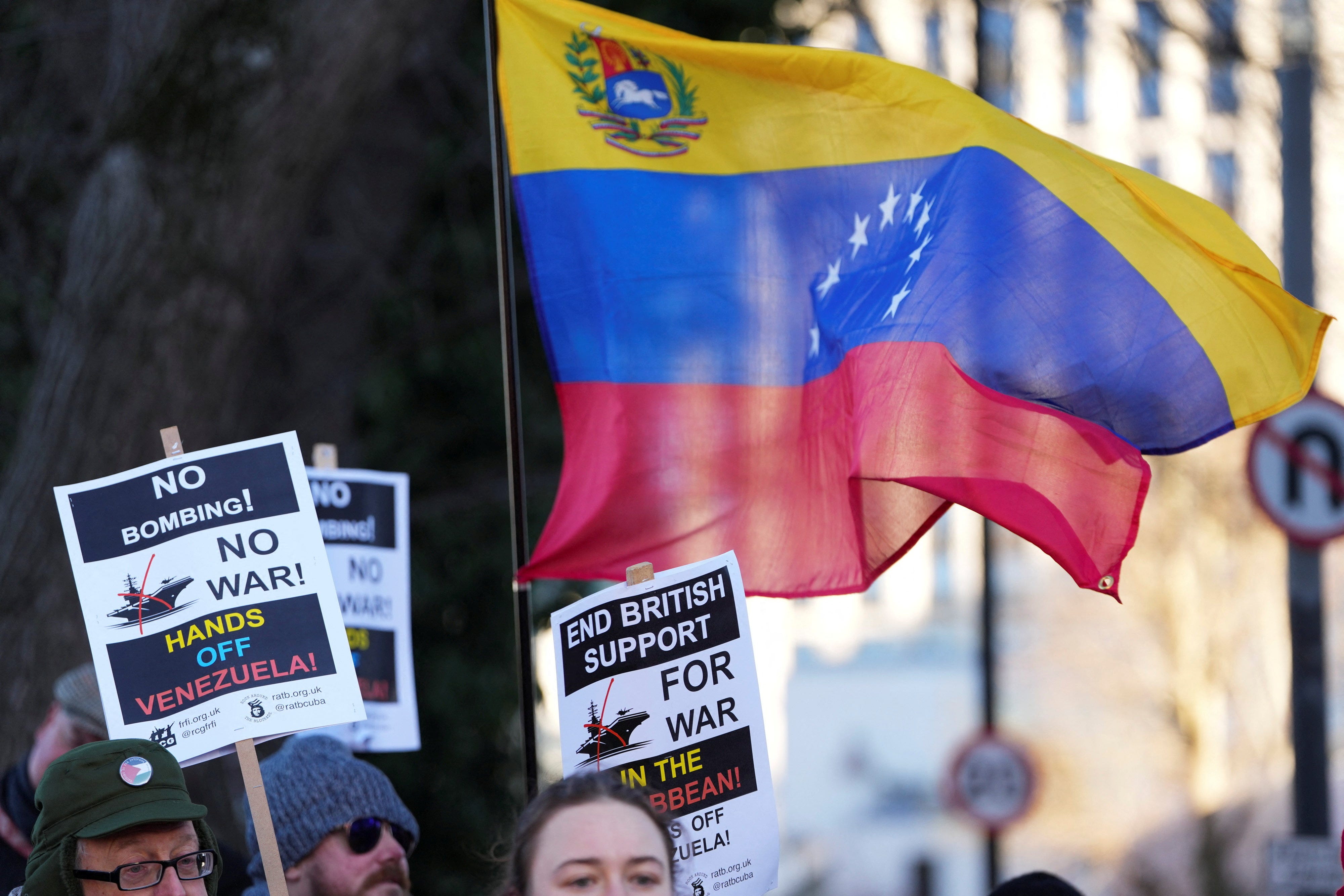
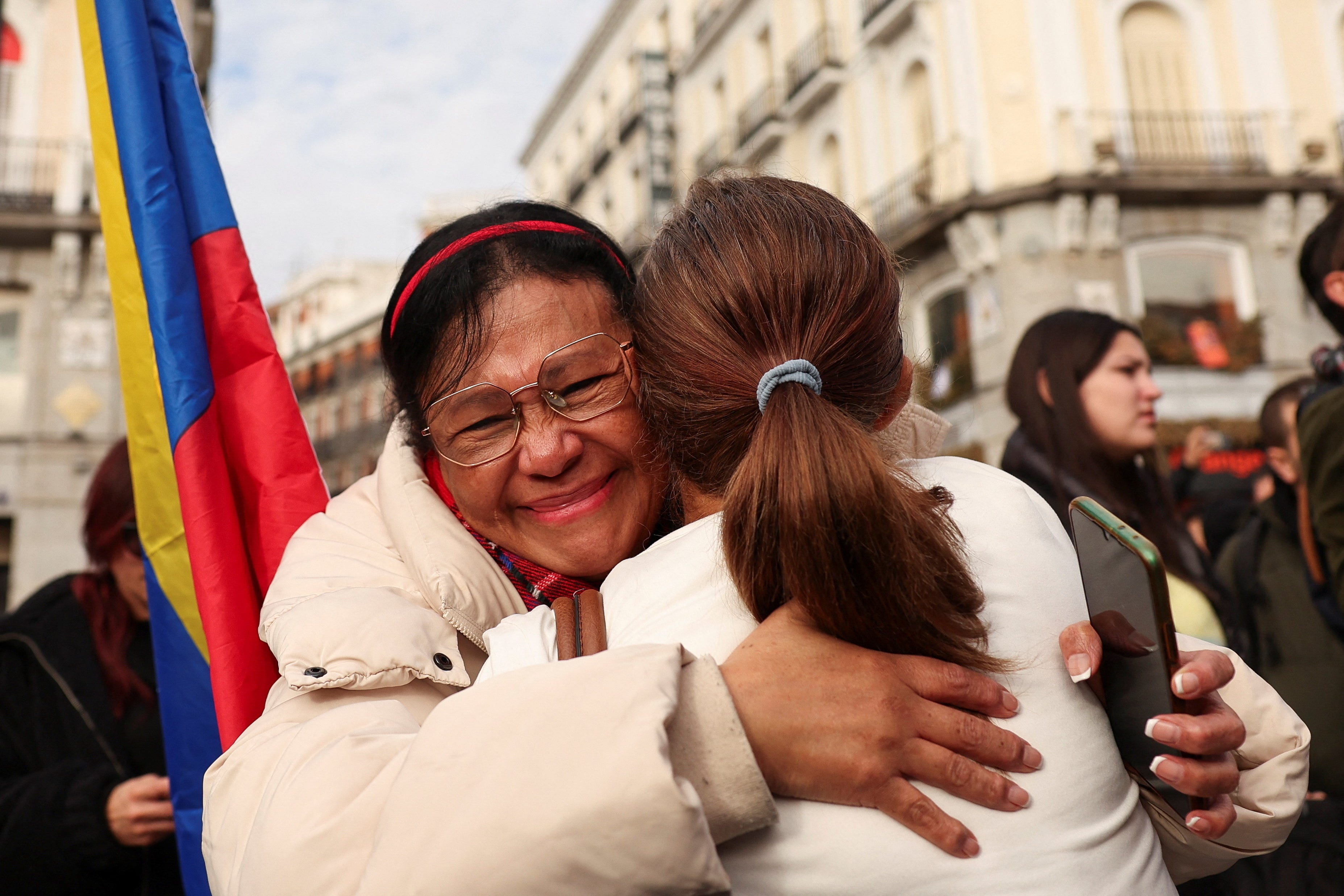
" style="max-width:100%; height:auto; border-radius:6px; margin:10px 0;" loading="lazy" /> A child holds a placard saying A woman reacts to the news after U.S. President Donald Trump said the U.S. has struck Venezuela and captured its President Nicolas Maduro, in Madrid, Spain, January 3, 2026. Armed supporters of Venezuela's President Nicolas Maduro gather near the Miraflores presidential palace in Caracas on January 3, 2026, after US forces captured him. A Venezuelan man living in Chile celebrates with a national flag and his car reading Venezuelans living in Chile celebrate in Santiago on January 3, 2026, after US forces captured Venezuelan leader Nicolas Maduro after launching a A man holds up a portrait of late Venezuela's leader (1999-2013) Hugo Chavez in Caracas on January 3, 2026, after US forces captured Venezuelan leader Nicolas Maduro. Activists of Socialist Unity Centre of India (SUCI) burn an effigy of US President Donald Trump during a rally in Kolkata on January 3, 2026, to protest against the recent US attack on Venezuela. A supporter of Nicolas Maduro holds a portrait of the Venezuelan President during a gathering near the Palacio de Miraflores in Caracas on January 3, 2026, after US forces captured Venezuelan leader Nicolas Maduro after launching a Venezuelans living in Chile celebrate in Santiago on January 3, 2026, after US forces captured Venezuelan leader Nicolas Maduro after launching a Venezuelans living in Chile celebrate in Santiago on January 3, 2026, after US forces captured Venezuelan leader Nicolas Maduro after launching a Demonstrators hold up a banner with the lettering reading 'Stop Trump - Free Venezuela' during a rally organised by left-wing 'Anti-Imperialist Coordination' (Antiimperialistische Koordination - AIK) under the motto 'Hands off Venezuela' at Vienna's Votive Park on January 3, 2026. The EU called for Demonstrators march with a banner with the lettering reading 'Hands off Venezuela' during a rally organised by left-wing 'Anti-Imperialist Coordination' (Antiimperialistische Koordination - AIK) in Vienna on January 3, 2026. The EU called for Venezuelans living in Peru celebrate outside the Venezuelan Embassy in Lima on January 3, 2026, after US forces captured Venezuelan leader Nicolas Maduro. President Donald Trump said Saturday that US forces had captured Venezuela's leader Nicolas Maduro after bombing the capital Caracas and other cities in a dramatic climax to a months-long standoff between Trump and Venezuelan. Venezuelans living in Peru celebrate outside the Venezuelan Embassy in Lima on January 3, 2026, after US forces captured Venezuelan leader Nicolas Maduro. President Donald Trump said Saturday that US forces had captured Venezuela's leader Nicolas Maduro after bombing the capital Caracas and other cities in a dramatic climax to a months-long standoff between Trump and Venezuelan. Venezuelans living in Peru celebrate at the Miguel de Cervantes park, near the Venezuelan Embassy in Lima on January 3, 2026, after US forces captured Venezuelan leader Nicolas Maduro. Venezuelans living in Peru dance to celebrate at the Miguel de Cervantes park, near the Venezuelan Embassy in Lima on January 3, 2026, after US forces captured Venezuelan leader Nicolas Maduro. A Venezuelan woman living in Peru celebrates with a national flag at the Miguel de Cervantes park, near the Venezuelan Embassy in Lima on January 3, 2026, after US forces captured Venezuelan leader Nicolas Maduro. Activists of Socialist Unity Centre of India (SUCI) protest against the recent US attack on Venezuela, in Kolkata on January 3, 2026. Members of the Communist Party of Britain (CPB) group hold banners outside the U.S. Embassy in London calling for People embrace next to a Venezuelan flag, as they react to the news after U.S. President Donald Trump said the U.S. has struck Venezuela and captured its President Nicolas Maduro, in Madrid, Spain, January 3, 2026.

See reactions after US explosions in Venezuela, Maduro capture

Reactions to theUnited States' bombing of Venezuela and capture of the country's president Nicolás Maduroranged across the world. Some celebrated the operation while others rebuked Trump's intervention in the South American country. See the reactions in photos, beginning here with Venezuelans living in Chile celebrating in Santiago on January 3, 2026.

Maduro's journey to NY: Ships, planes and helicopters

Maduro and Flores, landed in Brooklyn before heading to the Metropolitan Detention Center the evening of Jan. 3.

By then, they had been on multiple types of aircraft, plus a massive warship, in a journey spanning at least three nations and two time zones.

After the couple was taken from their Caracas home, they were loaded onto a helicopter, where the raid force had to fight its way out of Venezuelan airspace, according to Chairman of the Joint Chiefs of Staff. Gen. Dan "Razin" Caine.

More:'A lot of gunfire': Here's how the US raid to capture Maduro unfolded

They were then loaded onto the USS Iwo Jima, a U.S. Navy amphibious assault ship, and sailed across the Caribbean Sea to the U.S military base in Guantanamo Bay, Cuba.

Next, they were transferred to a plane to fly the final stretch to New York, landing shortly before sunset Eastern time at Stewart Air National Guard Base about 50 miles north of Manhattan. Once embarked, they were placed in helicopters and flown to Westside Heliport in Manhattan, then finally on to the Brooklyn detention facility.

Maduro walked down hallway in new footage

In the first clear video of the Venezuelan leader since he arrived on U.S. soil Saturday evening, Maduro was seen being walked down a hallway by federal agents.

The 12-second clip was posted to X by Fox News ContributorPaul Mauro and shared by the White House. In the video, Maduro is seen clutching a bottle of water and dressed in black pants, a black hoodie and hat.

His hands appear to be restrained, while three agents walk him down a hallway with a carpet that reads "DEA." He is overheard saying, "goodnight" and "happy New Year" before walking out of the video frame.

Venezuela Supreme Court orders VP become interim president

The Constitutional Chamber of Venezuela's Supreme Court ordered on Saturday that Vice President Delcy Rodríguez assume the role of acting president of the country.

The court ruling said that Rodríguez would assume "the office of President of the Bolivarian Republic of Venezuela, in order to guarantee administrative continuity and the comprehensive defense of the Nation."

The ruling added that the court will debate the matter in order to "determine the applicable legal framework to guarantee the continuity of the State, the administration of government, and the defense of sovereignty in the face of the forced absence of the President of the Republic."

This article originally appeared on USA TODAY:Why did we strike Venezuela, seize Nicolás Maduro? Live updates

Why did the US strike Venezuela and seize Nicolás Maduro? Live updates

Venezuelan leaderNicolás Maduroand his wife,Cilia Flores, awoke early Saturday morning to U.S. special forcescapturing th...
Women's Top 25 roundup: Utah works OT to hand No. 8 TCU first loss

Lani White sank a 3-pointer with 12 seconds left to force overtime and finished with a team-high 25 points as Utah upset previously unbeaten and eighth-ranked TCU 87-77 on Saturday night in Salt Lake City.

The Utes (11-4, 2-1 Big 12) outscored the Horned Frogs 20-10 in the extra period. Utah trailed for much of the game before an 18-11 third quarter gave it a two-point edge going into the fourth. The Utes' largest lead, 10 points, came at the end.

White made 9 of 17 from the floor, including 4 of 6 from 3-point range, and 3 of 3 at the free-throw line. Reese Ross added 15 points, Maty Wilke had 12 and Avery Hjelmstad and Brooke Walker (team-high eight rebounds) scored 10 points apiece. The Utes were 26 of 54 from the field, 13 of 23 from long range and 22 of 33 at the foul line.

Olivia Miles led TCU (14-1, 2-1 Big 12) with 31 points on 12-of-24 shooting from the floor, but shot 3 of 12 from long range. Marta Suarez added 23 points and 11 rebounds. Clara Silva contributed 10 points and nine boards and Donovyn Hunter added 11 points. The Horned Frogs were 28 of 75 from the floor, 9 of 39 on 3-pointers and 12 of 15 at the line.

No. 1 UConn 84, Seton Hall 48

Sarah Strong recorded 18 points, eight rebounds, four assists and four steals to lead the Huskies over the Pirates in a Big East Conference game in Hartford, Conn.

Strong played 25 minutes as UConn (15-0, 6-0 Big East) won its third straight game by at least 36 points. Teammate Azzi Fudd added 16 points and Allie Ziebell contributed 12 as the Huskies scored 35 points off 32 Seton Hall turnovers. UConn led 19-11 after one quarter, 38-18 at halftime and 67-26 after three periods.

For the Pirates (10-5, 4-2), Jordana Codio scored a team-high 12 points but committed 10 turnovers.

No. 4 UCLA 80, No. 17 Southern California 46

Lauren Betts recorded a double-double with 18 points and 12 rebounds and the Bruins pulled away by outscoring the Trojans 27-12 in the second quarter en route to their eighth consecutive victory.

UCLA (14-1, 4-0 Big Ten) was tied with its crosstown rival 16-16 after the first quarter before outscoring USC 64-30 the rest of the way. Gianna Kneepkens (15 points), Kiki Rice (14) and Gabriela Jaquez (12) also scored in double figures for the Bruins, who had a 46-26 advantage on the boards.

The Trojans' high scorer was Kara Dunn with 11 points, while star freshman Jazzy Davidson had 10 on 4-of-15 shooting from the field. USC (10-4, 2-1) shot 8 of 24 from 3-point range in having its three-game winning streak snapped.

No. 21 Texas Tech 80, Arizona 49

The Lady Raiders, already off to the best start to a season in program history, improved to 16-0 and 3-0 in the Big 12 with a rout of the Wildcats.

Five players scored in double figures for Texas Tech: Denae Fritz (16), Bailey Maupin (13) and reserves Adlee Blacklock (15), Jada Malone (14) and Snudda Collins (11). Gemma Nunez contributed eight rebounds and eight assists with no turnovers.

Stephanie Okechukwu, a 7-foot-1 freshman from Nigeria, sat on the team bench while awaiting the NCAA's ruling on her eligibility. She would be the tallest player in women's college basketball history. Without her, the Lady Raiders blocked a season-high 11 shots against Arizona (9-5, 0-3). Tanyuel Welch, with game highs of 19 points and nine rebounds, was the only Wildcat to score in double figures.

No. 25 Princeton 74, Penn 68

Olivia Hutcherson scored 20 points and Fadima Tall grabbed eight rebounds as the Tigers beat the Quakers in Philadelphia in the Ivy League opener for both teams.

Madison St. Rose added 15 points as Princeton (13-1) extended its winning streak to 11 games. The Tigers have not lost since an 84-68 setback to then-No. 9 Maryland on Nov. 16.

Penn (10-4) was led by Mataya Gayle's 17 points, seven rebounds and six assists. The Quakers outscored the Tigers 22-19 in the fourth quarter.

--Field Level Media

Women's Top 25 roundup: Utah works OT to hand No. 8 TCU first loss

Lani White sank a 3-pointer with 12 seconds left to force overtime and finished with a team-high 25 points as Utah ups...
Harry How/Getty; Steven Senne/AP Photo Amber Glenn

Harry How/Getty; Steven Senne/AP Photo

NEED TO KNOW

  • Figure skater Amber Glenn is hoping to qualify for her first Olympic games in Milan in February

  • Glenn, who has been skating since she was 5 years old, became the U.S. junior women's champion at age 14 — but took a step back from the sport amid a mental health crisis

  • She returned after receiving treatment, and has been racking up golds since 2023

Amber Glenn has just left the ice and is still peeling off her gear as she launches into a recap of her past few weeks. The 26-year-old recently recovered from a bout of the flu and is returning from the nearly non-stop travel typical for top figure skaters before the Olympics: photo shoots and commercials squeezed between competitions; interviews scheduled while her skates are still on.

On this recent afternoon she's chatty and candid despite feeling in the moment like a bit of a "mess," she tells PEOPLE. "I'm looking forward to this journey. It's been a long, very difficult road."

The 2025 women's national champion, Glenn hopes all of her work will propel her to qualify in January for her first Winter Games, in Italy the following month. She could be the only U.S. women's singles skater over the age of 25 — and the oldest in 98 years — as well as the only American woman who can land so many famously tricky triple axel jumps, her signature.

"No matter what she does," says dad Richard, 57, "she's gonna succeed."

Despite growing up in Plano, Texas, Glenn has never been a fan of the heat. At 5 years old, she found instant respite when her mom, Cathlene, took her to a local mall's skating rink. She insists she didn't stand out on the ice, not at first, but quickly began setting goals.

"Looking back, one thing I can say is I wasn't always the most graceful or talented or amazing skater, but there was determination," she says.

International Skating Union via Getty Amber Glenn on Nov. 23, 2024, in Chongqing, China

International Skating Union via Getty

But Cathlene, 49, tells PEOPLE her daughter reached a milestone within her first year on the ice.

"She landed her first single axel at the age of 6," she says. "That was kind of a big deal."

Her father, a police officer, took on side jobs to help fund the costs of the sport, while her mom worked at her rink and as a nanny for her coach to get discounted lessons. "We just had to kind of find ways to help finance her sport until she started getting funding," Cathlene says.

When Glenn was 14, she became the U.S. junior women's champion.

Then her path to victory veered off course. The following year she faced a mental health crisis that led a friend to raise concerns with her parents. She entered a facility and was diagnosed with anxiety, depression and an eating disorder. (Later she learned she also has ADHD.)

It was a dark time, she says, until she found some light from her inner circle: "I thought life was done for. There was eventually a spark that kept me going, that grew from the support around me and seeking help."

In 2019, Glenn came out as pansexual — which is when someone is attracted to people regardless of their gender — when she made a casual remark about her sexuality in an interview with a local magazine.

Jason Mowry/Icon Sportswire via AP Amber Glenn in Columbus, Ohio, on Jan. 26, 2024

Jason Mowry/Icon Sportswire via AP

"It was supposed to be a low-key little baby step, and then it was like, 'Oh, okay. All right. Guess we're doing this,' " she says, noting that while her remark "really took off," she had already ben out to her family and friends for a while at the time.

Still she braced for backlash. "There's hateful people out there, and you never know if one of those hateful people is gonna be a judge," she says.

Courtesy Amber Glenn Amber Glenn and her dog, Uki, on Dec. 30, 2023

Courtesy Amber Glenn

But the overwhelmingly positive reception felt like freedom, and she realized she can't control how others think: "Once I got past that, I felt like a weight was lifted off of me."

"I could really be me without any sort of judgment or preconceived notion of what I need to be like," she adds. "I feel like the expectations to be a pretty princess, you know, cookie cutter, was kind of taken back a little bit by stepping outside of the norm and just embracing who I am and saying, I'm gonna be me regardless of your opinions."

She started racking up golds in 2023, even amid other setbacks. She'd been in contention for Team USA at the 2022 Winter Olympics — before a positive COVID-19 test. The next year, she suffered a severe concussion, her second. She broke her orbital bones during both concussions, which she said caused brain damage.

Maddie Meyer/Getty Amber Glenn and her coach, Damon Allen (L) in Boston on March 28, 2025

Maddie Meyer/Getty

She has leaned on her parents, younger sister Brooke and coach Damon Allen, who got her through a recent anxiety attack so bad she felt like she couldn't breathe. "He's really good at bringing me back to earth," she says, while Cathlene calls Allen an "amazing human being." With Allen's help she's returning to a "more passionate, performative" style.

Never miss a story — sign up forPEOPLE's free daily newsletterto stay up-to-date on the best of what PEOPLE has to offer​​, from celebrity news to compelling human interest stories.

During downtime, Glenn relaxes with her dog Uki, plays the Magic: The Gathering card game or catches up on anime. One of her favorites, the Death Note franchise, inspired her competition makeup (which she also shows off to her many fans on social media).

Though she's still finding balance amid the highs and lows, she's not giving up. "My story is one of resilience and getting to live my life," she says, "not perfectly, but as me."

Read the original article onPeople

Amber Glenn, 26, Faced Concussions, Mental Health Crisis and Coming Out, Then Started Winning Golds: ‘I Never Gave Up’

Harry How/Getty; Steven Senne/AP Photo NEED TO KNOW Figure skater Amber Glenn is hoping to qualify for her first Olympic games in Milan i...


HOT POINT © 2015 | Distributed By My Blogger Themes | Designed By Templateism.com