Why did Alabama jump Notre Dame in CFP rankings? CFP chair explains

Thepenultimate College Football Playoff rankingsbefore the bracket is set hada big shift among teams on the edgeof making the playoff field.

Alabamajumped ahead ofNotre Dame, putting the Crimson Tide at No. 9 and theFighting Irishat No. 10. Notre Dame had been ahead of the Crimson Tide for the past two weeks, but even though both teams won their last regular season game,Alabamagot a slight jump ahead.

With the move, Alabama can feel more safe about making the playoff regardless of its result in the SEC championship game againstGeorgia. For Notre Dame, it should make the Fighting Irish a bit more nervous about being left out should some chaos happen in the Big 12 and ACC title games.

CFP chair explains Alabama-Notre Dame move

CFP selection committee chair Hunter Yurachek was asked on the ESPN broadcast about the move between the Crimson Tide and Fighting Irish.

He said it has been "one of the strongest debates" in his time on the committee, and this week it was about their final game of the regular season. Notre Dame defeated Stanford 49-20 in its annual rivalry game and Alabama beat Auburn 27-20 in the Iron Bowl.

"Notre Dame went on the road, had a strong win at Stanford, but Alabama went on the road in a rivalry game. Looked really good, especially in the first half, getting up 17-0, ran the ball well," Yuracheck said. "Auburn came back at them, they had a great gutsy call on 4th-and-2 late in the third quarter to get a touchdown, and then got the turnover late in that game.

"I think that was enough to change the minds of a couple of committee members to push Alabama up ahead of Notre Dame in this week's rankings," he added.

Alabama Crimson Tide linebacker Deontae Lawson (0) reacts during the second half against the Auburn Tigers at Jordan-Hare Stadium.

Yurachek was asked by Rece Davis if the move was to ensure if Alabama lost in the SEC title and Brigham Young won the Big 12 championship, the Crimson Tide wouldn't get knocked out of the field. He responded it wasn't.

"We will evaluate the results of the championship game after they're all completed over the weekend," Yurachek said.

Alabama can clinch its spot in the playoff in the SEC championship game against Georgia on Saturday, Dec. 6 while Notre Dame will have to wait to see if it makes the field.

This article originally appeared on USA TODAY:Why did Alabama jump Notre Dame in CFP rankings? CFP chair explains

Why did Alabama jump Notre Dame in CFP rankings? CFP chair explains

Thepenultimate College Football Playoff rankingsbefore the bracket is set hada big shift among teams on the edgeof mak...
INGLEWOOD, CALIFORNIA - APRIL 02: Ben Simmons #25 of the LA Clippers looks on against the New Orleans Pelicans during the first half of a game at Intuit Dome on April 02, 2025 in Inglewood, California. (Photo by Michael Owens/Getty Images)

The 2025 offseason came and went without Ben Simmons finding a team. He now appears to have a destination very much in mind.

The former first overall NBA Draft pick saw his career hit a nadir last year with his release by the Brooklyn Nets and an unproductive stay with the Los Angeles Clippers. He remains a free agent, and indicated an interest in returning to the Philadelphia 76ers when he liked an Instagram comment saying he'd be a good fit for the team last week.

He further demonstrated his interest on Tuesday, when he responded to a question about the Sixers by saying he'd play there for free, while alluding to other issues, such as his health.

View this post on Instagram

The exchange:

If @sixers asked you back to play center / pf would you come back on minimum contract would you

Simmons: it aint about the $, id hoop there for free. Its deeper then what they make y'all believe which is why i keep it pushing 🤐 rn the focus is gettin the body to 100% before putting my health on the line again… like i have been the past few years

So that's what Simmons has been up to lately.

The 29-year-old's career simply hasn't been the same since a messy divorce from the Sixers that saw him hold out of training camp and preseason and accrue nearly $20 million in fines,which resulted in a grievance and settlement. Philadelphia eventually traded him and his nine-figure contract to Brooklyn, but he was then sidelined by surgery for a herniated disc in his back.

Before the surgery, Simmons was offensively limited to his complete lack of shooting outside the paint, but still held value thanks to his passing, rebounding and first-team NBA All-Defense performance. Since the surgery, he has struggled to remain on the court and has seen his numbers crater across the board.

The idea of a healthy Simmons on a league-minimum contract — pretty much all he could get at this point — might hold some appeal for teams but, as the man himself said, he still actually has to reach 100 percent. And it seems doubtful the Sixers would be one of those teams, even with their own depth issues, considering the history there.

Still a free agent, Ben Simmons says he'd play for Sixers again for free

The 2025 offseason came and went without Ben Simmons finding a team. He now appears to have a destination very much in mind. The former fi...
Sasha DiGiulian becomes first woman to free-climb El Capitan's longest route

American climber Sasha DiGiulian has become the first woman to free-climb El Capitan's longest route — ajourneyshe said ended up being the "most formative and challenging climb" of her career.

"When we got to the top, after 23 days of this climb, I took a step and I just started laughing cause I was like, I haven't walked in so long," DiGuilian told CBS News in a phone interview Monday.

DiGiulian free-climbed the roughly 3,000-foot sheer granite wall in Yosemite National Park over the course of more than three weeks, nine days of which were spentwaiting out bad weatheron a wall ledge. Having eyed El Cap for years, DiGiulian is one of the few to summit via the long and difficult Platinum route.

American climber Sasha DiGiulian has become the first woman to free-climb El Capitan's longest route, the Platinum route. She completed the roughly 3,000-foot sheer granite wall in Yosemite National Park over the course of more than three weeks. / Credit: Pablo Durana

"For the last few years I've been so committed to this specific line ... This climb kind of consumed me," she said.

"I was drawn to this particular route because it just seemed so audacious and hard and intimidating, and that's what excited me about it," she said in a separate interview with CBS News' Carter Evans.

DiGiulian, 33, and her climbing partner Elliot Faber were periodically accompanied by support personnel and a videographer.

Made famous by the Oscar-winning documentary "Free Solo," which capturedclimber Alex Honnold's famed ascent in June 2017, El Capitan is more than twice the height of the Empire State Building in the northern valley of Yosemite National Park in California.

American climber Sasha DiGiulian has become the first woman to free-climb El Capitan's longest route, the Platinum route. She completed the roughly 3,000-foot sheer granite wall in Yosemite National Park over the course of more than three weeks. / Credit: Pablo Durana

The rock formation has 17 different free-climbing routes, according to DiGulian. Free-climbing is when climbers ascend with their hands and feet, using equipment and ropes only to protect against falling, which they set up in between pitches, or anchor points. In longer climbs like on El Capitan, climbers divide up the terrain into pieces.

DiGiulian holds a World Champion title in rock climbing and is based in Boulder, Colorado. She confirmed to CBS News that theclimbing emojiis based on her image.

DiGiulian said she and Faber arrived in Yosemite on Oct. 8 and began preparations to spend 14-16 days climbing the Platinum route, also known as the Direct Line, which has 39 pitches. They established rope points and hiked with more than 30 gallons of water to the top of the rock wall to be accessed later on.

Faberhelped establish the routeyears ago, mapping out credit card-sized protrusions on rock, but he had not actually climbed it. That changed on Nov. 3, when DiGiulian and Faber began their ascent.

Although they incorporated weather windows into their planning, an unforeseen storm brought everything to an abrupt halt on day nine. The duo set up camp on the 32nd pitch known as the mountain's Golden Edge to wait out wind, rain, cold and snow.

Sasha DiGiulian waits out bad weather on El Capitan in Yosemite National Park. An unforeseen storm brought her climb to an abrupt halt on day nine. / Credit: Sasha DiGiulian

"This is my portaledge," DiGiuliansaysin an Instagram video on Nov. 14.

The pair used a Jetboil to cook, ate freeze-dried food for dinner, consumed Send bars (a line of green protein bars DiGiulian invented herself), rationed Kindle battery to read, and went back and forth on airplane mode to communicate with the world below. DiGiulian also said the tent door flapping in the wind made it difficult to sleep. Despite battling fatigue, boredom and the elements, she said they enjoyed incredible mountain views, glorious sunrises and days on end to contemplate their mission.

"The storm was kind of this mental but also physical challenge because you're just stripped of any sense of normal," DiGiulian said.

"The winds were what scared me a lot, and then there was really intense thunder and lightning, she told Evans.

Finally, after several days of being unable to climb, the weather started to let up. Despite the wet and slippery rock — very difficult climbing conditions — the pair resumed their ascent after 18 days on the wall, nine of which were spent waiting out the storm.

The remaining terrain was some of the most difficult, and not made easier by the slick surfaces, DiGiulian said. She put on a helmet due to the ice chunks falling from the 400 feet above.

Sasha DiGiulian participates in the first-ever National Outdoor Recreation Executive Forum hosted by Outdoor Recreation Roundtable at Decatur House on May 7, 2024, in Washington, D.C. / Credit: Paul Morigi

"I don't know what it is that enabled me to like to climb this route and get through it beyond just sheer drive to push myself," she told CBS News.

Just short of the summit, Faber had to leave El Cap due to a family emergency. DiGiulian waited on the wall for two days, hoping they could finish together. When Faber was ultimately not able to return, he gave his partner his blessing to summit alone.

"He was just kind, I guess, between a rock and a hard place," DiGiulian said.

Accompanied by some friends and a camera crew, DiGiulian summited El Capitan on Wednesday, Nov. 26, after a grueling 23 days — the first woman to free-climb the ascent on the Platinum route.

"I came over the edge and tears started to kind of consume me," she told CBS News, adding, "I'm going to remember this climb for the rest of my life."

It usually takes climbers multiple days to reach the summit, depending on the route's difficulty. El Capitan draws tens of thousands of climbers each year, according to Yosemite National Park, most taking 5-7 days to summit (on the easier routes, weather conditions permitting) and 60% of climbers typically succeed.Emily Harrington became the first woman to summit the rock formation in under 24 hoursvia the Golden Gate route in 2021.

DiGiulian has been adventuring since childhood. "Climbing is this space for me where I get to be really locked in and focused on what my physical and mental self is capable of," she said. "I love puzzle solving."

Florida charter school company run by GOP figure leaves parents frustrated: "They dropped the ball"

Trump reacts to report alleging Hegseth gave verbal order on no survivors in Venezuela boat strike

Key Tennessee special election underway between Republican Matt Van Epps and Democrat Aftyn Behn

Sasha DiGiulian becomes first woman to free-climb El Capitan's longest route

American climber Sasha DiGiulian has become the first woman to free-climb El Capitan's longest route — ajourneyshe sa...
San Francisco sues nation's top food manufacturers over ultraprocessed foods

The city of San Francisco filed a lawsuit against some of the nation's top food manufacturers on Tuesday, arguing that ultraprocessed food from the likes of Coca-Cola and Nestle are responsible for a public health crisis.

City Attorney David Chiu named 10 companies in the lawsuit, including the makers of such popular foods as Oreo cookies, Sour Patch Kids, Kit Kat, Cheerios and Lunchables. The lawsuit argues that ultraprocessed foods are linked to diseases such as Type 2 diabetes, fatty liver disease and cancer.

"They took food and made it unrecognizable and harmful to the human body," Chiu said in a news release. "These companies engineered a public health crisis, they profited handsomely, and now they need to take responsibility for the harm they have caused."

Ultraprocessed foods include candy, chips, processed meats, sodas, energy drinks, breakfast cereals and other foods that are designed to "stimulate cravings and encourage overconsumption," Chiu's office said in the release. Such foods are "formulations of often chemically manipulated cheap ingredients with little if any whole food added," Chiu wrote in the lawsuit.

The other companies named in the lawsuit are PepsiCo; Kraft Heinz Company; Post Holdings; Mondelez International; General Mills; Kellogg; Mars Incorporated; and ConAgra Brands.

None of the companies named in the suit immediately responded to emailed requests for comment.

U.S. Health Secretary Robert F. Kennedy Jr. has been vocal about the negative impact of ultraprocessed foods and their links to chronic disease and has targeted them in hisMake America Healthy Againcampaign. Kennedy has pushed to ban such foods from the Supplemental Nutrition Assistance Program for low-income families.

AnAugust reportby the U.S. Centers for Disease Control and Prevention found that most Americans get more than half their calories from ultraprocessed foods.

In October, California Gov. Gavin Newsomsigned a first-in-the-nation lawto phase out certain ultraprocessed foods from school meals over the next decade.

San Francisco's lawsuit cites several scientific studies on the negative impact of ultraprocessed foods on human health.

"Mounting research now links these products to serious diseases—including Type 2 diabetes, fatty liver disease, heart disease, colorectal cancer, and even depression at younger ages," University of California, San Francisco, professor Kim Newell-Green said in the news release.

The lawsuit argues that by producing and promoting ultraprocessed foods, the companies violate California's Unfair Competition Law and public nuisance statute. It seeks a court order preventing the companies from "deceptive marketing" and requiring them to take actions such as consumer education on the health risks of ultraprocessed foods and limiting advertising and marketing of ultraprocessed foods to children.

It also asks for financial penalties to help local governments with health care costs caused by the consumption of ultraprocessed foods.

San Francisco sues nation's top food manufacturers over ultraprocessed foods

The city of San Francisco filed a lawsuit against some of the nation's top food manufacturers on Tuesday, arguing tha...
Winter storms blanket the East, while the US West is wondering: Where's the snow?

Ski season is here, but while the eastern half of the U.S.digs out from wintery storms, the western U.S. snow season has been off to a very slow start.

The snowpack wasfar below normalacross most of the West on Dec. 1, 2025. Denver didn't see its first measurable snowfall until Nov. 29 – more than a month past normal, and one of itslatest first-snow dates on record.

But a late start isn't necessarily reason to worry about the snow season ahead.

Adrienne Marshall, ahydrologist in Coloradowho studies how snowfall is changing in the West, explains what forecasters are watching and how rising temperatures are affecting the future of the West's beloved snow.
NOAA

What are snow forecasters paying attention to right now?

It's still early in the snow season, so there's a lot of uncertainty in the forecasts. A late first snow doesn't necessarily mean a low-snow year.

But there are some patterns that we know influence snowfall that forecasters are watching.

For example, the National Oceanic and Atmospheric Administrationis forecasting La Niña conditions for this winter, possibly switching to neutral midway through. La Niña involves cooler-than-usual sea-surface temperatures in the Pacific Ocean along the equator west of South America. Cooler ocean temperatures in that regioncan influence weather patternsacross the U.S., but so can several other factors.

Chart: The Conversation/CC-BY-ND, Source: NOAA

La Niña – and its opposite, El Niño – don't tell us what will happen for certain. Instead, they load the dice toward wetter or drier conditions, depending on where you are. La Niñas aregenerally associatedwith cooler, wetter conditions in the Pacific Northwest and a little bit warmer, drier conditions in the U.S. Southwest, but not always.

When we look at the consequences for snow, La Niña does tend to mean more snow in the Pacific Northwest and less in the Southwest, but, again, there's a lot of variability.

USDA Natural Resources Conservation Service

Snow conditions also depend heavily on individual storms, and those are more random than the seasonal pattern indicated by La Niña.

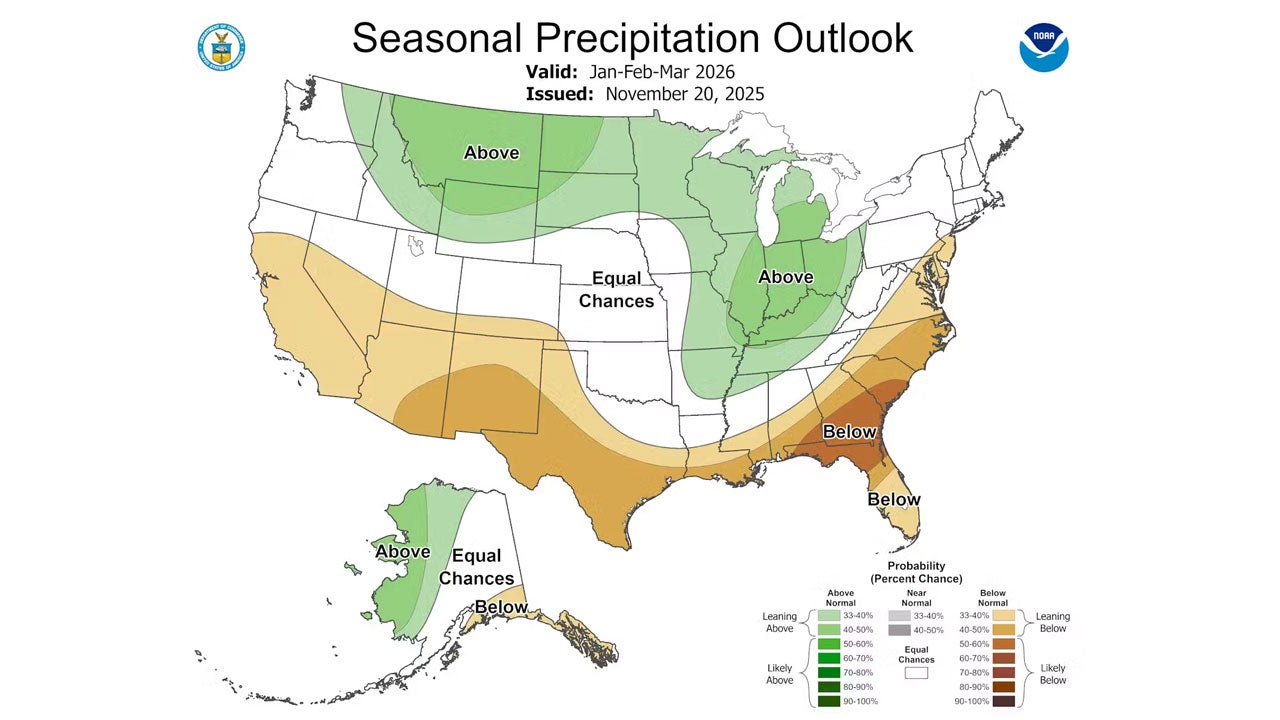
If you look atNOAA's seasonal outlook maps, most of Colorado and Utah are in the gap between the cooler and wetter pattern to the north and the warmer and drier pattern to the south expected during winter 2026. So, the outlook suggests roughly equal chances of more or less snow than normal and warmer or cooler weather across many major ski areas.

How is climate change affecting snowfall in the West?

In the West, snow measurements date back a century, so we can see some trends.

Starting in the 1920s, surveyors would go out into the mountains andmeasure the snowpackin March and April every year. Those records suggestsnowfall has declinedin most of the West. We also see evidence ofmore midwinter melting.

How much snow falls is driven by both temperature and precipitation, andtemperature is warming.

Chart: The Conversation, CC-BY-ND, Source: NOAA

In the past few years, research has been able todirectly attribute observed changesin the spring snowpack to human-caused climate change. Rising temperatures have led to decreases in snow, particularly in the Southwest. The effects of warming temperatures on overall precipitation are less clear, but the net effect in the western U.S. is a decrease in the spring snowpack.

When we look atclimate change projections for the western U.S.in future years, we see with a high degree of confidence that we canexpect less snow in warmer climates. In scenarios where the world produces more greenhouse gas emissions, that'sworse for snow seasons.

Should states be worried about water supplies?

This winter's forecast isn't extreme at this point, so the impact on the year's water supplies is a pretty big question mark.

Snowpack – how much snow is on the ground in March or April –sums up the snowfall, minus the melt, for the year. The snowpack also affects water supplies for the rest of the year.

TheWest's water infrastructure systemwas built assuming there would be a natural reservoir of snow in the mountains. California relies on the snowpack forabout a thirdof its annual water supply.

However, rising temperatures are leading toearlier snowmelt in some areas. Evidence suggests that climate change is also expected to causemore rain-on-snow eventsat high elevations, which can cause very rapid snowmelt.

Luis Sinco/Los Angeles Times via Getty Images

Both create challenges for water managers, who want to store as much snowmelt runoff as possible in reservoirs so it's available through the summer, when states need it most for agriculture and for generating hydropower to meet high electricity demand. If the snow melts early, water resource managers face some tough decisions, because they also need to leave room in their reservoirs to manage flooding. Earlier snowmelt sometimes means they have to release stored water.

When we look at reservoir levels in the Colorado River basin, particularly the big reservoirs – Lake Powell and Lake Mead – we see apattern of decline over time. They have had some very good snow and water years, and also particularly challenging ones, including along-running drought. The long-term trends suggest an imbalance between supply andgrowing demand.

Chart: The Conversation, CC-BY-ND, Source: U.S. Bureau of Reclamation

What else does snowfall affect, such as fire risk?

During low-snow years, the snowpack disappears sooner, and thesoils dry out earlierin the year. That essentially leaves a longer summer dry period andmore stress on trees.

There is evidence that we tend to havebigger fire seasons after low-snow winters. That can be because the forests are left with drier fuels, which sets the ecosystem up to burn. That's obviously a major concern in the West.

Snow is also important to a lot of wildlife species that are adapted to it. Oneexample is the wolverine, an endangered species that requires deep snow for denning over the winter.

What snow lessons should people take away from climate projections?

Overall, climate projections suggest our biggest snow years will beless snowy in anticipated warmer climates, and thatvery low snow yearsare expected to be more common.

But it's important to remember that climate projections arebased on scenariosof how much greenhouse gas might be emitted in the future – they are not predictions of the future. The worldcan still reduce its emissionstocreate a less risky scenario. In fact, while the most ambitious emissions reductions are looking less likely, theworst emissions scenarios are also less likelyunder current policies.

Understanding how choices can change climate projections can be empowering.Projections are saying: Here's what we expect to happen if the world emits a lot of greenhouse gases, and here's what we expect to happen if we emit fewer greenhouse gases based on recent trends.

The choices we make will affect our future snow seasons and the wider climate.

This article has been updated to correct the references to Denver, which saw one of its latest snowfalls on record.

Adrienne Marshall, Assistant Professor of Geology and Geological Engineering, Colorado School of Mines

Winter storms blanket the East, while the US West is wondering: Where’s the snow?

Ski season is here, but while the eastern half of the U.S.digs out from wintery storms, the western U.S. snow season has ...
Debris is piled up at the entrance to Camp Mystic on July 7, 2025 in Hunt, Texas. (Brandon Bell / Getty Images file)

Camp Mystic has announced its plan to reopen next summer with new safety measures aftermore than two dozen people were killed in floodsat the all-girls Texas summer camp earlier this year.

Twenty-seven children and camp counselors died after slow-moving thunderstorms in Kerr County caused the Guadalupe River to flood.

In a message to parents issued Tuesday, the camp said it is preparing for next summer's event at their newer Cypress Lake location, which is "completely independent from the older Guadalupe River camp, with a separate entrance, waterfront, dining hall, office, pavilion, infirmary, playing fields, archery range, stables, chapel, and cabins," according to their website.

The camp said it has taken steps to enhance security at the location, including installing over 100 flood monitoring units along Cypress Lake and the South and North forks of the Guadalupe River.

"The system will provide early detection of high-water events, as it communicates for miles with other sensors using LoRaWAN (low-range wide-area network) technology, allowing campers, counselors and staff to respond and quickly and safely evacuate to an elevated muster station," the camp said.

An officer prays with a family as they pick up items at Camp Mystic in Hunt, Texas on Wednesday, July 9, 2025.  (Ashley Landis / AP)

Hand-held two-way radios with weather alerts from the National Oceanic and Atmospheric Administration will be added to each cabin, and the camp's internet will be backed up with satellite internet, the camp said. The campdoes not allow attendees to have their phones, and cell service at the Guadalupe camp earlier this year was reportedly spotty.

The camp will also add "higher-capacity generators to maintain power in critical areas," like the office and dining hall.

"These enhancements will also help us maintain communication with emergency personnel and parents in the event of an emergency," the camp said in the message.

The 2026 camp dates start on May 30 and end on Aug. 9, designating 10-day stints for girls of different ages, the camp said. Enrollment has not yet opened.

On the morning of July 4, the Guadalupe River in Kerr Countyoverflowed as a result of consistent rainfall, putting Camp Mystic attendees asleep in their cabins at risk.

"We recognize that returning to Camp Mystic carries both hope and heartache," the camp acknowledged in the message to parents. "For many of your daughters, this return is not simple, but it is a courageous step in their healing journey."

The camp is also offering tours of the Cypress Lake location in April where families can ask questions.

Camp Mystic to open with new safety plan after 27 kids and counselors died in Texas floods

Camp Mystic has announced its plan to reopen next summer with new safety measures aftermore than two dozen people were killed in floodsat t...
Texas' Steve Sarkisian questions why team bothered to play Ohio State

Texas coach Steve Sarkisian is questioning why his team played defending champion Ohio State this season with it looking possible his squad will miss the College Football Playoff field.

The No. 16 Longhorns (9-3) upset then-No. 3 Texas A&M on Friday to keep their hopes alive. But losses to then-No. 3 Ohio State, unranked Florida and then-No. 5 Georgia are a problem with several teams with fewer losses also in contention for at-large berths.

"Why did we even play Ohio State?" Sarkisian said on SiriusXM on Tuesday of the 14-7 loss. "Because if we're a 10-2 team right now that played four top-10 ranked opponents with three top-10 wins, we're not even having a discussion right now. So, my point is: Why the hell am I going to play that game next year? For what? What good does it do?"

The Buckeyes and Longhorns are slated to meet in 2026 in Austin, so perhaps next time Texas notches a big victory and isn't in a similar position.

Then again, Sarkisian says the CFP guidelines make it feel like there is no need to play a team like Ohio State.

"I'm looking at the principles of the CFP," Sarkisian said. "I'm looking at the sheet of paper right now. The first two bullet points say strength of schedule and head-to-head competition. That's the frustrating part. So, to me, when you talk about future scheduling -- and we don't get in? -- what's the point in playing them. There's no benefit to that.

"And we're going to nine games in the SEC next year. I get it, there's going to be a network (ESPN) upset if we don't play that game, because there's probably going to be 15 to 16 million viewers that would watch that game. But I get no benefit from playing the game. It does nothing for me. I have a responsibility to the University of Texas and our players to put them in the best position."

Prior to Tuesday night's reveal of the latest CFP rankings ahead of championship weekend, Texas has head-to-head victories over three Southeastern Conference programs ranked in the top 10 at the time in which the teams played -- No. 6 Oklahoma, No. 9 Vanderbilt and No. 3 Texas A&M. The Longhorns lost to No. 5 Georgia and didn't face Ole Miss or Alabama.

The big blow is the 29-21 loss to Florida on Oct. 4, a team that fired coach Billy Napier 15 days later.

No. 12 Miami of the Atlantic Coast Conference is one of the other teams facing the same uphill climb as the Longhorns. And the two coaches exchanged barbs on Monday.

Sarkisian criticized Miami coach Mario Cristobal on Monday for the Hurricanes scoring a touchdown with 41 seconds left to pad the victory margin in Miami's 38-7 win over Pitt on Saturday.

"There's teams that are ranked in front of us that haven't played any top-10 ranked teams," Sarkisian said on SEC Network. "My point to everybody is, is this about what your record is at the end? Or is this about beating quality teams and showing how good of a team you really are by beating quality teams on the field. Or is it don't play good teams, put up a bunch of yards, put up a bunch of points and make it look good. Throw fade route touchdowns with 38 seconds to go when you're ahead 31-7 so that the score looks better.

"Is the committee watching the games or are they looking at a stat sheet at the end of the game to say, 'Oh, well they won by this many points, they must've played really good.'"

Cristobal was only too happy to return serve and use Florida (4-8) as an example, a common opponent of both teams. The Hurricanes beat the Gators 26-7.

"I get it, everybody's trying to posture themselves for their programs and whatnot. The great part about stuff like that when coaches try to speak about themselves like that, they also gotta take a look at the common opponent between us and that particular coach," Cristobal said on Canes In Sight. "Seeing that we had the opportunity to really dominate that opponent while that opponent dominated them."

Miami played one top-10 team, beating Notre Dame 27-24 in its season opener.

--Field Level Media

Texas' Steve Sarkisian questions why team bothered to play Ohio State

Texas coach Steve Sarkisian is questioning why his team played defending champion Ohio State this season with it looking ...


HOT POINT © 2015 | Distributed By My Blogger Themes | Designed By Templateism.com