Matt Harmon Fantasy analyst Thu, October 15, 2026 at 12:23 AM UTC · 13 min read About Our Ads Advertisement Advertisement Advertisement At the close of fantasy draft season this summer, the Chicago Bears had five players in the top 70 overall. So far, only D'Andre Swift drafters are remotely happy with that. Even with some bumps lately, he's still the RB12 in points per game after being drafted as the RB19 in Round 4.
Neither Luther Burden nor Rome Odunze at wide receiver has consistently made a difference, and tight end Colston Loveland at 38th overall is arguably the worst pick on the board through five weeks.
In general, I don't want to make any sweeping conclusions or grand pronouncements about this group of pass-catchers until we get a more extended view of how everything sorts out when Chicago has its starting quarterback.
Caleb Williams has played one full game this season; the Bears scored 59 points in that contest while Williams looked like an evolved version of his 2025 self. He didn't put the ball in harm's way, kept the offense on schedule, and took shot plays when available but opted for checkdowns and layups when they weren't. The Bears were the best offense in the NFL in Week 1 and even if the run game was awesome and Williams was excellent as a scrambler, they boasted the fourth-best success rate on passing plays. Williams operated as the type of quarterback most of his detractors insist he simply will never be in the NFL in that win.
Join or create a Yahoo Fantasy Basketball league for the 2026-27 NBA season
Things fell apart in Week 2 when the team played against Brian Flores and the NFL's No. 1-ranked defense — by a long shot based on EPA per play and success rate allowed — in a rainstorm. Williams didn't finish the game after suffering a hamstring injury after playing 87% of the snaps.
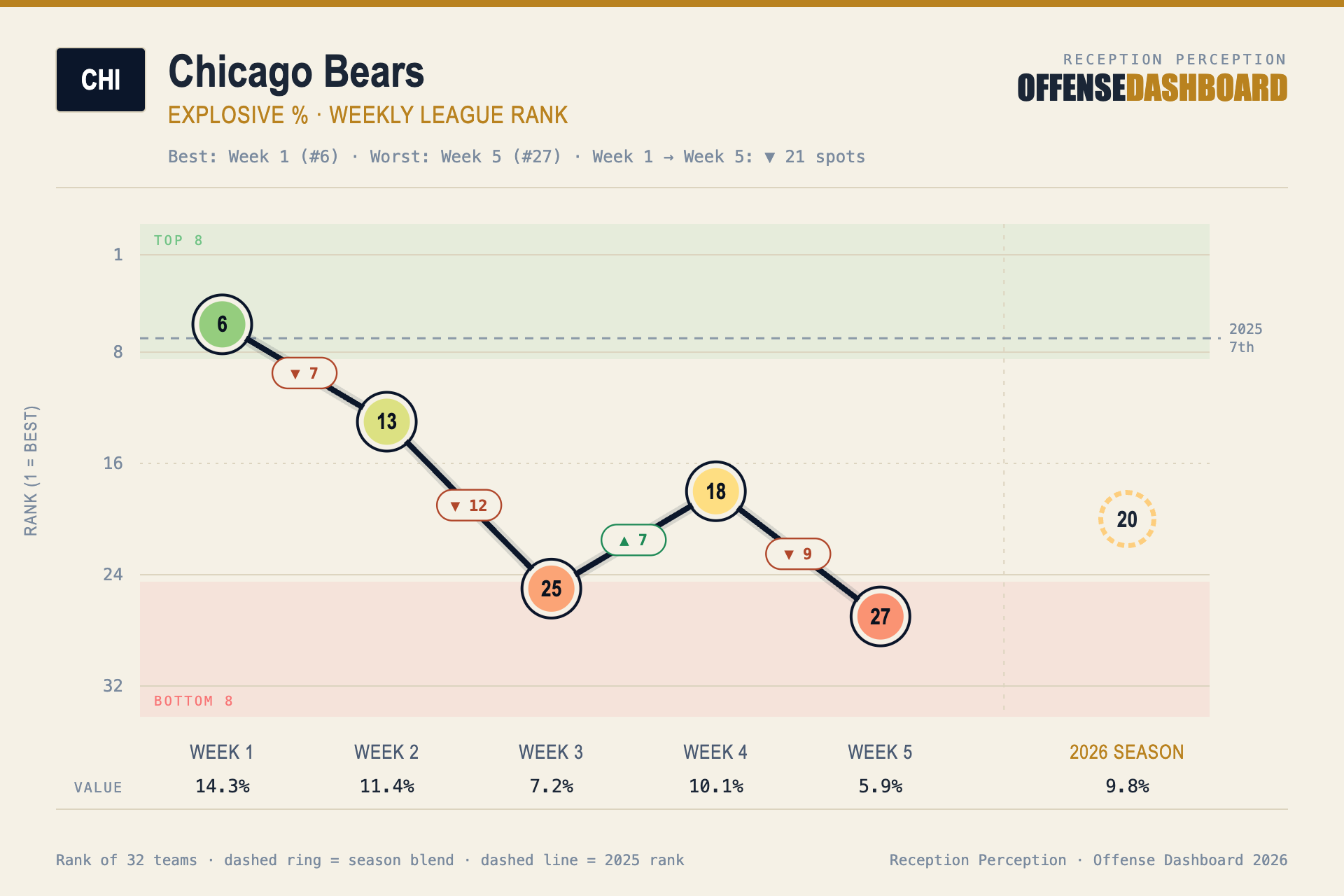
In a tale as old as time, the backup quarterbacks played well in each of their respective first starts in a well-designed Ben Johnson offense but haven't sustained that momentum because they can't push the ball downfield. This is best expressed in the Bears ranking 20th in explosive play rate through five weeks, after finishing seventh in 2025. They are still eighth in explosive rushing rate, so the pass game is the bigger anchor here.
In Weeks 3 to 5, they ranked 28th in explosive play rate overall but first in time of possession per drive. If you've watched Ben Johnson offenses, you know he prioritizes explosive plays, not just holding onto and moving the ball. This has been their biggest issue.
The return of their uber-talented young quarterback who can attack every blade of grass should solve most of this. But how much will it move the needle for each individual player? That's what we'll look into in this space.
We should acknowledge that the Bears are not one of the most concentrated passing trees in the NFL. They are one of 10 teams with five or more players who own a 10% target share. Their top two players (Luther Burden III and Rome Odunze) combine for a 39.5% target share; that's the 12th-lowest for a top duo among all NFL teams.
No one projected Kalif Raymond to finish the first five weeks with a 16.7% target share and 14.5% air yard share, both of which rank third on the team. He's really complicated the distribution and has siphoned layup targets away from the supposed top-three players. Now, his designed plays were quite effective in Weeks 1 to 3 but have gone nowhere the last two games (12 yards on six targets). His route participation has also dipped below 60%; his role may be shrinking, which wouldn't be a massive shock for a 32-year-old veteran role player. If he sticks around, it'll make the margin for error even tighter for the three young mainstays.
Burden has been the biggest victim of the offense's lack of explosive plays. His average depth of completion is below 7 yards.
So far, the Bears haven't been able to activate him outside of designer targets close to the line of scrimmage. Without a doubt, there have been plays on dig in-breaking routes where he's gotten open the last few weeks, and the ball just doesn't find him. There were several examples in Week 5 with Tyson Bagent under center.
Those were the mainstays in Burden's route diet as a rookie and where he's meant to be most useful to the Bears offense as an explosive player.
I'm confident Williams, who hit Burden on a few of these exact routes in Week 1 against Carolina, will be able to get the ball here better than Bagent or Case Keenum.
The issue for Burden to date, and it's still early in Year 2, is that neither his role nor play style has expanded from his rookie season. Burden has not run a route on 80% or more of the dropbacks in any game this season. He's run a route on only 39% of dropbacks when there are two or fewer receivers on the field. You can be the most efficient player in the league but it's quite hard to be a productive player week-in-week-out when that's your role.
That needs to change for Burden to hit the ceiling his ADP suggested this summer. He needs to come close to completely removing Raymond from the rotation to get there. The problem is that I don't think he's winning on enough real-deal receiver routes to push the veteran or command more downfield looks overall. The plays where he gets open are there; they just need to happen more consistently. I would have said the same thing about his rookie season and college tape.
I still remain a fan of Burden's game overall and am not writing him off whatsoever. Getting Williams back under center will help his weekly ceiling outcomes. He just needs to take a few more steps forward to lift his floor. If and when he does, his play style and deployment make it easy for quarterbacks to find him and get him the ball to run after the catch.
Odunze has not consistently popped off either but for almost the exact opposite reasons as Burden.
Odunze has no playing time issues. He's run a route on 82% of the dropbacks with two or fewer receivers on the field from Weeks 2 to 5 after he was a part-time player in the season opener. He has had no issues getting open at all levels of the field. Odunze has become one of the best route runners and separators in the NFL. It's quite easy to see on tape.
The problem, from a pure production standpoint, is that he plays the highest-difficulty role in the wide receiver room. His average depth of route is 10.7 yards downfield, per Fantasy Points Data, while everyone else on the team is below 8.0. He doesn't get the same layup crossers or quick slants that go the way of Burden or Raymond. While he is not a sacrificial X-receiver, he does take the most snaps outside and on-ball on the team. He doesn't run an above-average rate of go routes (15%) but his primary route diet comes from big posts, digs and corners.
Odunze is excellent on those patterns and they are critical to the team hitting the explosive plays that Johnson so desires to make the base of his offense. Yet, that role has a ton of variance, regardless of how good a player might be in isolation. We've seen that in just the last two games. When the quarterback is protected and playing on time, as Bagent was in Week 4, the X-receiver can be the primary target and be the reason his team thrives in the passing game. When things go a bit more awry, as they certainly did in Week 5, that player can come away with 3-40 even when they lead the team in targets.
If we're calling balls and strikes here, Odunze has also made some of his own problems the last two seasons with big mistakes at critical times. Some of that is overstated this year, as he has only one drop — a particularly disgusting one in the end zone in Week 3 in an island game — and sports the best contested-catch rate on the team of 75%, per Fantasy Points Data. Still, in a crowded offense in a low-percentage role, you need to make the most of every opportunity.
Odunze's role as the vertical X-receiver definitely needs a quarterback like Williams to thrive. He is the most susceptible to chaos. Even still, Odunze doesn't play in the most "fantasy-friendly" role and that will lead to volatility; even more so if Williams suffers bouts of inaccuracy that haunted him in 2024 and 2025 when throwing downfield. I remain bullish on their connection but I could see this being a similar situation to another elite separator, Brandon Aiyuk, when he was the downfield X-receiver for the 2022 and 2023 49ers with tons of other layup options on the team. Aiyuk didn't crack 110 targets in 2023 but cleared 1,300 yards because he was outrageously efficient in a good ecosystem.
Odunze needs to clean up some areas of his game to reach that final, long-shot level and it definitely won't happen either way without the version of Williams we saw in Week 1.
Loveland is maybe the trickiest one to figure out — a shame considering he was the earliest drafted player of the bunch. Right now, he's fourth on the team in both targets and air yards. No one signed up for that. Raymond's presence has been a big hindrance to his outlook, as they run routes in similar areas of the field. Loveland has just one game with a target share north of 14%. It came in Week 4 when Raymond had a season-low 6% target share … that's not a coincidence.
In Week 1, Loveland ran a route on 89.5% of the dropbacks, even if he didn't catch a pass. Since then, his route participation has been below 77% in every game. In his dominant stretch as the clear leading player in the Bears passing game from Week 16 through the playoffs, Loveland ran a route in 81% of dropbacks and was targeted on 30.5% of those pass patterns. We just aren't seeing anything close to that usage right now.
One of Loveland's superpowers in that stretch was his ability to play out-wide as a mismatch option. He averaged 3.08 yards per route run lined up outside in that five-game stretch, totaling 154 yards and 12 catches on 20 targets. So far, this season, he's caught just three passes for 25 yards on six targets in five games when lined up out-wide. He caught all of his passes in Week 4.
To my eye test, he hasn't looked as explosive or fluid as a separator on those reps in particular through the first five weeks as he did in the back half of his rookie season. That is a small sample and could just be a blip. It's just one explanation for why he hasn't popped in this role. His air yards per target on his looks outside is 7.5, well south of his five-game stretch from Week 16 through the playoffs last year (10.2). He just hasn't been getting the same chunky downfield looks in those advantageous spots as we saw in 2025. It's easy to tell yourself a convincing story that this changes with Williams back in the mix.
My other theory, in addition to simple variance and a small-sample slump, as to why Loveland's production is down is that it's not an uncommon issue for tight end production; he's blocking more often. For the Bears offense, this isn't a bad thing at all. Loveland is one of the best blocking tight ends among full-time starters who are also, in theory, highly dangerous pass-catchers.
In the run game, Loveland is a weapon. That he isn't a defensive tell and is also a mismatch weapon as a receiver is what made him special last year.
However, so far in 2026, he's stayed in to pass block on 13.2% of his snaps, way up from 5.8% overall in 2025 and in the Week 16 to Divisional Round run rate of 3.9%. Again, this is helpful to the Bears' offense. Williams isn't the only starter the team is currently missing. Chicago has played the start of the season without left tackle Ozzy Trapilo, who was fantastic as a rookie but tore his patellar tendon in the 2025 postseason. The team rotated Braxton Jones and Theo Benedet at left tackle around their four other stalwart starters before Jones went on IR. Benedet is an athletic mover in the run game but leaky in pass protection. It makes sense for Loveland to have to help out until Trapilo returns.
Even in plays with three or more receivers on the field, Loveland has pass-blocked on 14% of his plays and has run a route on only 70% of the team's total dropbacks. These may seem like small shifts but from a pure production and much less fantasy standpoint, these make all the difference on the margins for tight ends. It's even more true when a passing tree is more crowded than expected, as is clearly the case in Chicago.
If Trapilo, who is on the active roster, dresses for game day here soon, we still need to see if he can get back to form in short order. If he does, it could free Loveland up to run more routes and be deployed as a pass-catcher. There's also a chance that this is how Loveland will help his team this year as Trapilo returns from a serious injury, which may take time to get back to 100%. That would be a big boost for a Bears offense that's destined to rise in the ranks the moment Williams returns. It just won't move the needle for Loveland's depressed fantasy outlook.
Ultimately, I'm still buying on Colston Loveland as a long-term talent, just as I am on both of his young wide receiver teammates, Luther Burden and Rome Odunze. Aside from a few individual critiques, backup-quarterback influence and shifting external factors have largely shaped the box-score results for all three players. We know the quarterback is returning soon, and likely this week, which will undoubtedly help. The question is just how much it moves the needle for all three of these talented players, and all of them have at least one other quandary that needs solving, beyond Williams getting back under center.
Source: Sport


0 Comments